Resonance
 I'm Chris. This is an overview of resonance.
The world doesn't teach people how to sit with feelings. So when other people have big emotions, people fix them, explain them away, or use reassurance.
Resonance is an alternative. When someone is wanting to vent or get advice, instead of giving them solutions/reassurance/fixes, try resonance. It's similar to active listening. Active listening gives you paraphrasing and open ended questions. Resonance adds on three new tools: copies, guesses, and exaggerations.
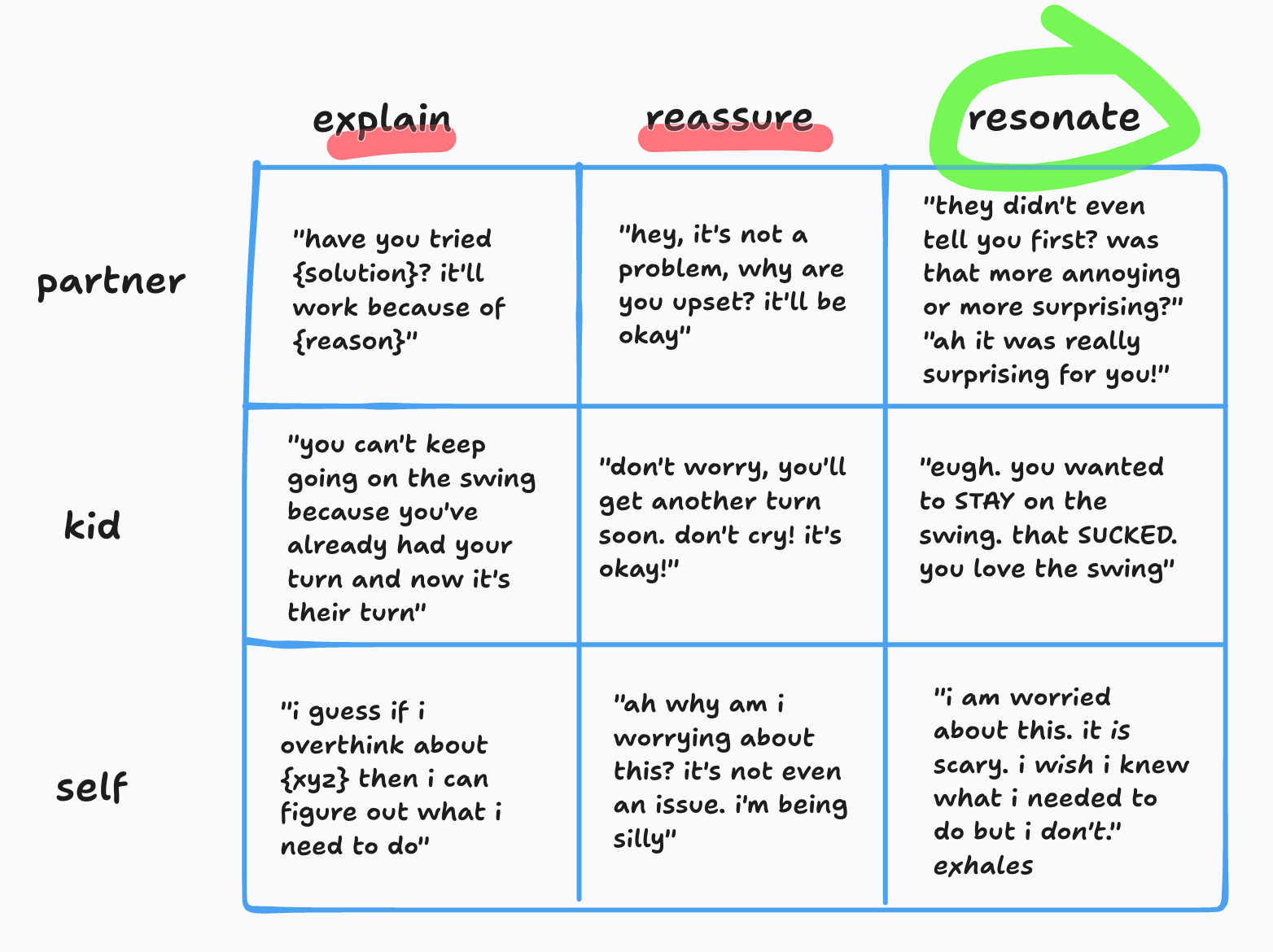
When emotions are high, using explanations or reassurance buries the other person's emotions. Their emotions stay stuck, unprocessed.
Instead, good resonance can help them process/digest their emotions (by feeling seen). Then once the emotions are digested and everyone's feeling neutral, then move onto the solutions/logic/fixes, if still needed.
It's the same story in parenting, relationships, coaching, with cofounders, and with yourself.
Resonance works by making others feel seen.
What's the downside? It takes effort to learn. The first 30 minutes feel robotic and fake. After another 30 minutes, you start to get it. With a few months of occasional practice you'll get the skill.
People love to feel seen, heard, and understood.
Here's a 24 second video of me resonating my son - this is a situation where he's stressed, I'm relaxed, and I'm using resonance to support him in processing his emotions.
To learn the basics, check these videos
Relationship Resonance Examples
Podcast excerpt:
Full episodes
FAQ
More examples? Here are Two more resonance with kids examples.
How to use this for self-regulation? Guide.
Can you give me text to give to an AI? Resonance AI Prompts
Will the other person notice it's a technique? Yes, they might notice, and yes, it can still work. Give close relationships a heads up that you're trying something new and it might seem weird. Ask them to let you try it in 10 conversations. Start practicing in situations that don't involve you, before using it in arguments.
What are the limitations? If you have no desire to make the other person feel seen, it won't work - try resonating with yourself first. You can't learn it in high stakes situations. Resonance can prevent tantrums, but doesn't stop them once started.
How might you use it as a parent?
- Easy - Car rides and pre-bed: purely reflecting on their experiences.
- Easy - Play: observing and describing what they're doing without adding opinions.
- Medium - When your kid is upset and you're calm: help them process.
- Hard - Enforcing boundaries while staying connected. Practice easy ones first.
What are the common mistakes?
- People over-paraphrase and slip advice or opinions into their paraphrases.
- People put advice or solutions into their guesses.
- People tell the other person what they think or what they realize, rather than staying with what the other person is saying and showing.
What are the common hesitations when learning? "This feels robotic/fake" and "there's too much to think about." These fade after 30-60 minutes of practice.
How do you know if it worked? If the other person says "yes, exactly!!" or they breathe a sigh of relief or they become much more open or relaxed.
What other tools have I tried that I now use resonance instead of? IFS (internal family systems), coherence therapy, core transformation, conscious leadership group clearing model, focusing and felt sense, alexander technique, wholeness method, the five love languages and apology languages, Swedish massage, John Sarno (it combines well, basically you can just resonate body parts/areas), somatic experiencing, bioemotive, motivational interviewing, ACT, CBT, transcendental meditation.
My favorite other tools are, in order: core transformation, John Sarno, Swedish massage, 5 love languages, and IFS.
Do I have to agree with them? No. You can resonate even when you disagree: "you really think the sky is green - and you wish I thought the sky was green too!" In disagreements, resonate first until they say "yes exactly you get it", then take 5-10 minutes of space, then decide what to do. Longer answer.
I've collected more resources/questions in my replies here.
Thank you to the people who inspired this: Nina, Matt Mochary, Alejandro Martinez, Mark Andreas, Tamara Andreas, and Steve Freund. Thank you to my friends for being beta testers.
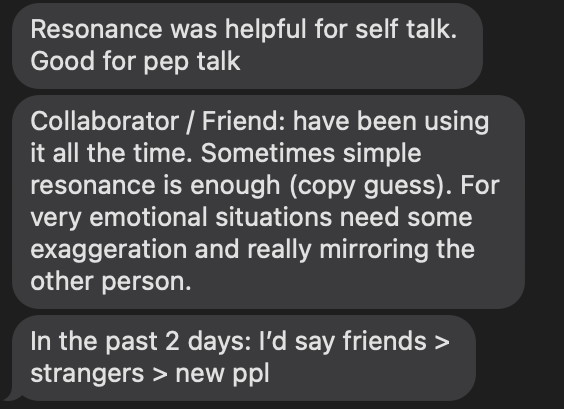
Quotes from friends about how they use resonance
 my wife Nina (with our kids)
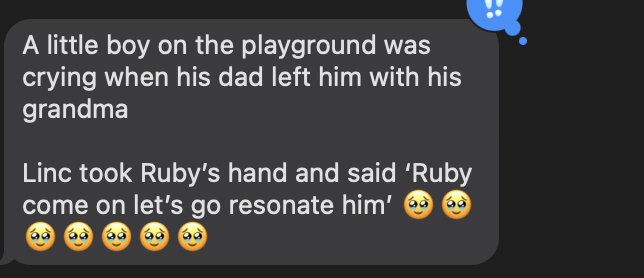
 Maile Minardi (friends, relatives)
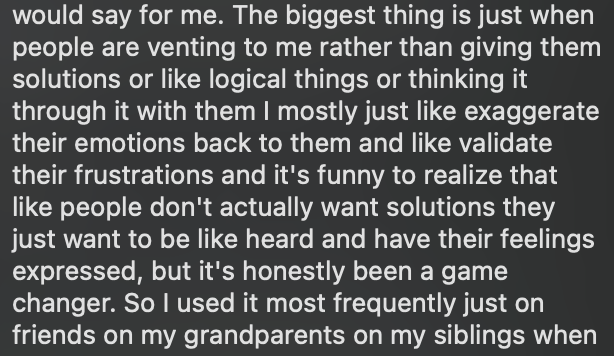
my sister (nursing patients)

Justin Yang (supporting friends)

my brother (self, supporting friends)
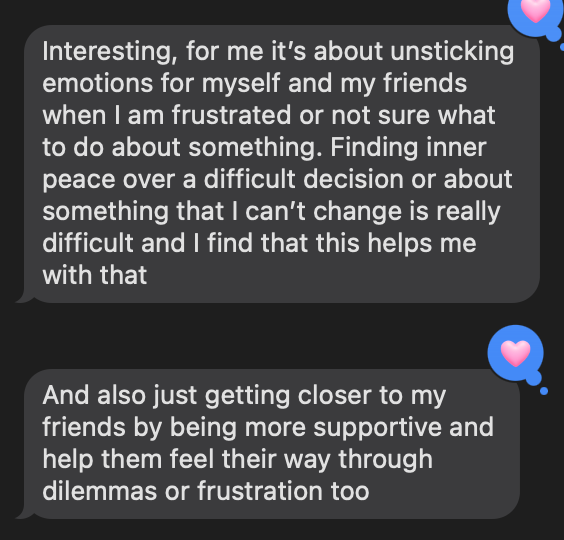
 Ben Pan (self, friends)
"I think it's one of the most useful skills I've ever learned."
See also: Peaceful Preferences
About me: Chris Barber